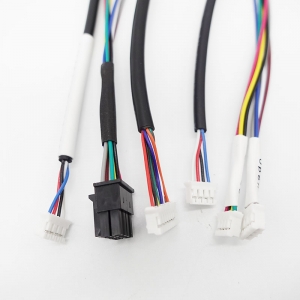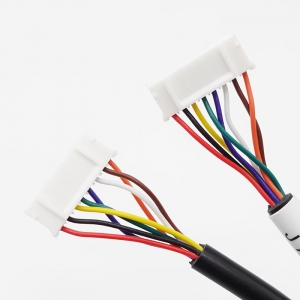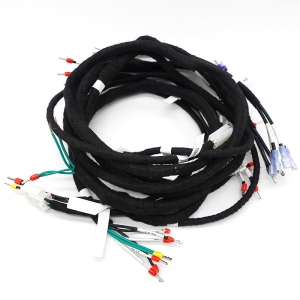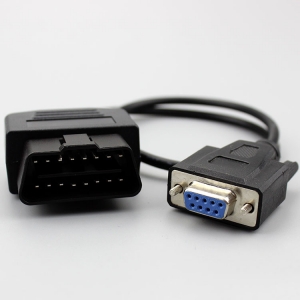
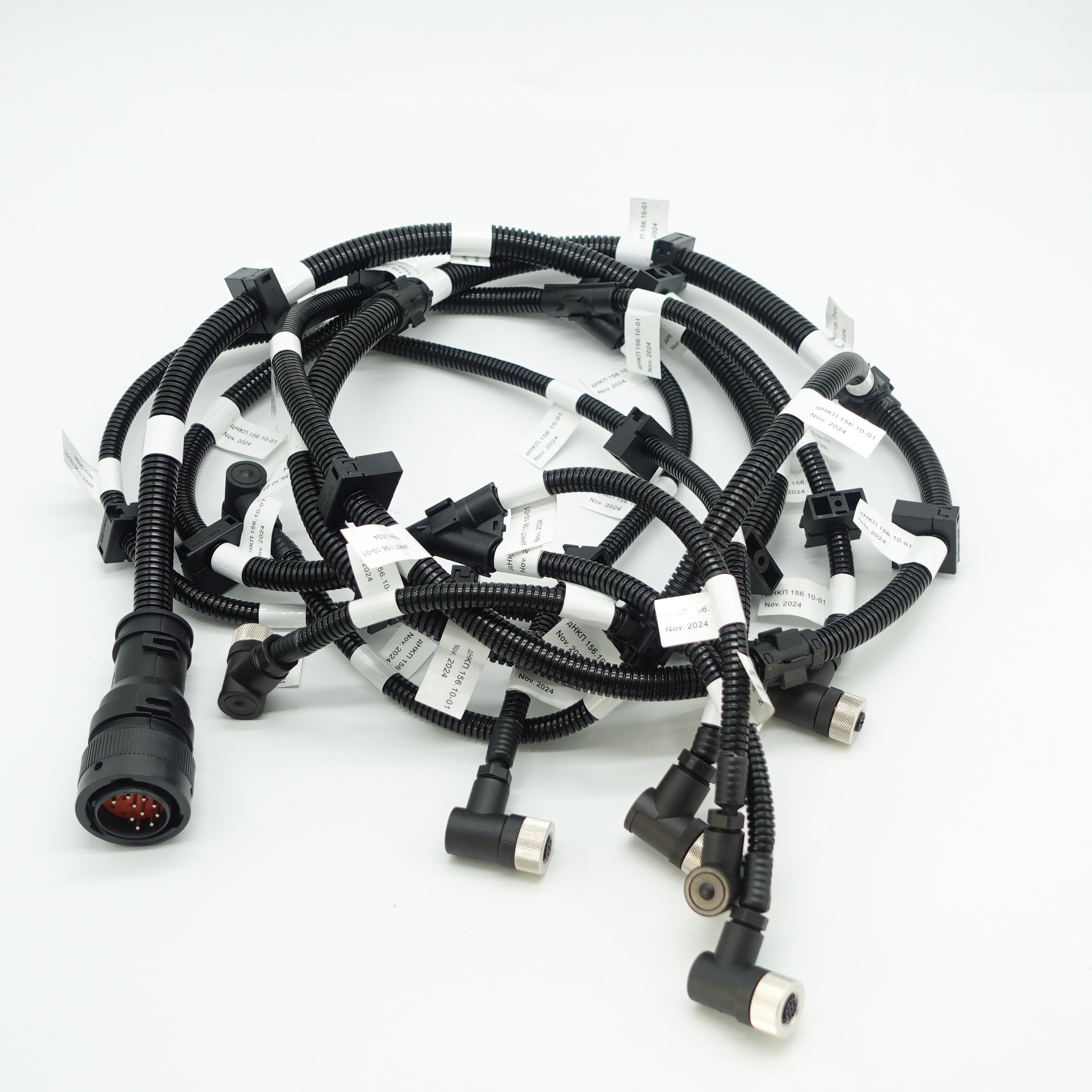
Wire harnesses are transitioning from passive “nerve bundles” to intelligent “neural networks.” Here is a deep analysis of the five major technological trends reshaping their future and a forward-looking vision.
1. High-Voltage & High-Current Systems: The Core of the EV RevolutionThe shift to 400V/800V architectures in electric vehicles is fundamentally redefining power harness engineering. This demands more than just color coding (orange for high voltage).
-
Material Science Breakthroughs: Specialized cross-linked polyethylene (XLPE) and silicone rubber are replacing traditional PVC for insulation, offering superior dielectric strength and thermal stability above 150°C.
-
Advanced Safety Architectures: High Voltage Interlock Loops (HVIL) and manual service disconnect (MSD) units are now standard, ensuring that high-voltage circuits are always safely isolated before any manual intervention.
-
Thermal & EMC Management: The combination of high current and high switching frequencies requires advanced strategies for heat dissipation and electromagnetic compatibility (EMC), often involving complex shielding and coolant channel integration.
2. Data-Centric Harnesses: The Rise of the "Nervous System"
Modern vehicles and complex machinery are becoming data centers on wheels. This is driving the integration of high-speed data protocols directly into traditional power harnesses.
-
From CAN to Multi-Gigabit: Alongside legacy Controller Area Network (CAN) and Local Interconnect Network (LIN) buses, there is rapid adoption of Automotive Ethernet (100/1000BASE-T1), capable of speeds over 1 Gbps to support sensor fusion and autonomous driving.
-
Signal Integrity as Paramount: This evolution necessitates precision-impedance-controlled cables (e.g., shielded twisted pairs), stringent crosstalk mitigation strategies, and connectors designed for stable high-frequency performance.
3. The Relentless Pursuit of Miniaturization & Weight Reduction
The drive for greater efficiency and packaging density is relentless, particularly in aerospace and automotive sectors.
-
Component-Level Shrinking: The use of smaller-gauge, high-temperature wires, micro- and nano-miniature circular connectors, and flat Flexible Printed Circuits (FPCs) is increasing.
-
Topology Optimization: Advanced software is used to design optimized 3D routing paths, minimizing length and material use without compromising serviceability—a process known as harness topology optimization.
4. Industry 4.0 in Harness Manufacturing: The Smart Factory
Manufacturing is undergoing a digital transformation to enhance precision, traceability, and efficiency.
-
Digital Twin & Simulation: Virtual prototyping of the entire harness—including electrical performance, mechanical fit, and manufacturability—using digital twins is reducing design iterations and physical rework.
-
Advanced Automation: While final assembly remains skill-intensive, processes like automated wire processing, robotic crimping, and computer-vision-guided quality inspection are becoming standard, ensuring consistency and providing full traceability from raw material to finished product.
5. Sustainability: From Design to End-of-Life
Environmental responsibility is evolving from a preference to a core design requirement.
-
Green Material Selection: There is a significant shift toward bio-based or recyclable polymer sleeves, halogen-free flame-retardant (HFFR) insulation, and low-VOC (volatile organic compound) tapes.
-
Circular Economy Principles: Manufacturers and OEMs are jointly exploring designs for disassembly and recycling, investigating ways to efficiently separate metals from polymers at a harness's end-of-life.
The Integrated Future: The "Smart Harness"
The ultimate trend is the convergence of these vectors into an integrated system. The future "Smart Harness" may incorporate:
-
Embedded Diagnostics: Optical fibers or dedicated sense wires for continuous health monitoring (temperature, chafing, moisture ingress).
-
Zonal Architectures: Reducing complexity and weight by using centralized computing and simplified, localized distribution hubs.
-
Additive Manufacturing: The potential for 3D-printed connectors or cable guides that conform to unique, space-constrained geometries.
The wire harness is evolving from a static assembly into a sophisticated, optimized, and intelligent subsystem. Its future lies in seamlessly integrating power delivery, high-fidelity data networks, and embedded intelligence, all while being lighter, manufactured with precision, and designed with its full lifecycle in mind.